
Stirling Engine
More actions
| Properties | |
|---|---|
| Stacks | Yes (10) |
| Autoignition | 300°C |
| Flashpoint | 100°C |
| Recipe | |
| Created With | Electronics Printer |
| Cost | 5 Gold, 20 Copper, 30 Steel |
| Logic | |
| Item Hash | -1821571150 |
| Item Name | ItemKitStirlingEngine |
.jpg)
| Operation | |
|---|---|
| Power Usage | 1W |
| Burst Pressure | 11 MPa |
| Volume | 54L+5L+5L |
| Thermal Convection | ~1.248 m² |
| Thermal Radiation | ~1.248 m² |
| Solar Heating | 8.51 |
| Prefab Hash | -260316435 |
| Prefab Name | StructureStirlingEngine |
| Construction | |
| Placed with | Kit (Stirling Engine) |
| Placed on | Small Grid |
| Requires Frame | Yes |
| Stage 1 | |
| Deconstruction | |
| Deconstructed with | Hand Drill |
| Item received | 2x Electronic Parts |
| Stage 2 | |
| Deconstruction | |
| Deconstructed with | Wrench |
| Item received | 2x Steel Sheets |
| Stage 3 | |
| Deconstruction | |
| Deconstructed with | Hand Drill |
| Item received | Kit (Stirling Engine) |


| Recipe | |
|---|---|
| Created With | Electronics Printer, Autolathe |
| Cost | 6 Iron, 9 Gold, 26 Copper, 31 Steel |
Description
Harnessing an ancient thermal exploit, the Recurso 'Libra' Stirling Engine generates power via the expansion and contraction of a working gas to drive pistons operating an electrical generator.
When high pressure hot gas is supplied into the input pipe, this gas will heat the hot side of the unit, then pass into the output pipe. The cooler side uses the room's ambient atmosphere, which must be kept at a lower temperature in order to create a differential. Add a working gas by inserting a Gas Canister. The unit must be deactivated when adding or removing canisters, or the working gas may leak into the surrounding atmosphere.
Gases with a low molecular mass make the most efficient working gases. Increasing the moles of working gas can result in a greater potential power output. However, overpressuring the unit may have... sub-optimal results.
Efficiency
The Stirling Engine has an efficiency curve that is dependent on three factors:
- Environment
- Working Gas
- Pressure Difference
The best a Stirling Engine can provide in power is 18% efficiency converting input heat to electric power, slightly more efficient than a Gas Fuel Generator's 17%. However, the gas fuel generator's exhaust can be passed into a stirling engine for a higher total combined efficiency.
Environment
The Stirling engine itself is best placed in a -10~50°C environment to provide the highest efficiency. The only planets where it cannot effectively be used outside are: Venus, Moon and Mimas. On Vulcan it can only be used outside during the night.
The operating temperature efficiency curve is measured at the cold side, which performs convection with the environment's atmosphere through a 3.5m² radiator.
-
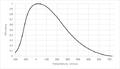 Temperature efficiency curve

In World
- Moon (Vacuum): 0%
- Venus: 18% efficiency @ 464°C
- Vulcan (Night): 90.1% efficiency @ 126°C
- Mars: 99% @ -10°C
- Europa: 28% @ -147°C
These figures assume no load. In particular, Mars will not reflect these figures without forced air intake as the low atmospheric pressure will result in poor thermal conductance between the radiator and cold side. At 0.04atm, expect a thermal conductance of only 14 W/K.
In Room
The Stirling engine can be kept in a 1+ atm room to cool the cold side down at maximum efficiency (350W/K thermal conductance), but because all wasted heat needs to be removed, this requires an effective cooling system. At the maximum power output of 8 kW, a minimum cooling capacity of 8/0.18 ~= 44.4 kW is required to get rid of waste heat.
Working Gas
The working gas is a canister of gas that must be provided to the machine before it can be used. The gas itself is not lost, only used as a heat transfer gas.
It's shared between 3 chambers: a 54L regenerator chamber, a 5L hot piston chamber, and a 5L cold piston chamber. Only the 5L chambers are used for energy generation, with the regenerator acting as both a heat exchanger between them and as a secondary radiator (~1.275 m² convection/radiation area).
If the regenerator chamber ever reaches a difference of 11 MPa relative to environment atmosphere, the machine will have a chance of instantly exploding. This sets a limit on maximum safe operation temperature based on how many mols are present in the canister. At 60 mols, that's 1411 K assuming a loss-of-cooling scenario.
Different working gases achieve different efficiencies. Here are the efficiencies of several gasses:
- Steam: 5%
- Pollutants: 5%
- Carbon Dioxide: 8%
- Oxygen: 12%
- Nitrogen: 12%
- Nitrous Oxide: 12%
- Ozone: 12%
- Methane: 15%
- Helium: 18% (Best)
- Hydrogen: 18% (Best)
Mixed gases have their efficiencies weighed by their ratios in the mix. Liquids have a 0% working efficiency.
Pressure Difference
The Stirling Engine works best when the difference between hot side's pressure is at least 2500 kPa greater than the cold side. This can be achieved by increasing the amount of working gas, or by increasing the temperature range between hot and cold sides.
Besides controlling the cold side's temperature as suggested in the environment section, the hot side's temperature can be controlled in two different ways: Increasing the input's temperature, and, to a lesser extent, increasing the input's pressure (which works better at higher working gas thermal masses).
Unlike the cold side's heat exchanger, which has the entire cell the stirling engine is in to exchange heat with, the hot side's heat exchanger only exchanges heat with a single 10L pipe segment at a time (even though it has 2 m² of heat exchange area to work with). Because of the low volume being exchanged at a time, low input pressures may reach a hot side heat exchanger equilibrium temperature far below the actual input temperature, leading to a colder output but also a colder hot side temperature.
Power Generation
The difference in energy between hot and cold sides is calculated, with the result(after all efficiencies are multiplied) being converted into energy and removed from the hot side before hot and cold sides are mixed again into the regenerator for another cycle (being effectively wasted heat). A well-tuned Air Conditioner or phase change loop can make a stirling engine produce significantly more power than the supporting equipment required to run it in an isolated environment. [1]
Because of the 8 kW power generation limit, additional energy is wasted as heat. As an optimally-efficient stirling engine needs to produce at least 5520 W[2], this makes for a fairly narrow full-efficiency operating range.
User Comments
The Stirling Generator has a maximum pressure differential of 11000 KPa (11 MPa): If the difference in pressure between the internal working gas and external atmosphere exceeds this, it will explode in a radius of 2-4m, destroying everything in its path and killing players.
The power output scales on how fast it can transfer heat from the input gas to the outside atmosphere, which depends on the pressure and heat transfer rate of the working gas, and the temperature difference between the input gas and the outside temperature. The cooled down input gas is transferred to the output pipe - you can connect the output to the input in order to extract heat energy from a pipe network.
To increase the pressure differential efficiency, you can increase the temperature delta between the input gas and the outside atmosphere, increase the input gas pressure, or increase the working gas pressure(if it doesn't pose enough of a danger to warrant lowering hot side temperatures).
Details
Max power: 8000W
Maximum internal-external pressure differential: 11000kPa
Environment operating efficiency: Around 285-300K for 100%
Minimum power for maximum internal pressure differential efficiency: 5520 W[2]
Maximum working gas efficiency: 18% (0.18) with Helium or Hydrogen
Technical details
Ideal pressure differential: 2500
Internal volume: 54L
Piston volume: 5L
Heat exchanger volume: 10L
Hot side area: 2
Cold side area: 3.5
Convection factor: 0.15
Radiation factor: 0.15
Surface area: 8.499227
Vulcan
The Stirling Engine is a reasonable way to generate night time power on Vulcan when solar power is unavailable. Place it outside so it's in night time (400K) atmosphere, and capture mid-day (900 to 950K) atmosphere into a tank and run the Stirling Generator from that hot air at night, the generator can produce around 1.8 kW from the temperature difference. For the working gas, a good starting point is 70 moles of H2 in the canister. You can boost the power output to about 2.1kW by using an active vent to blow cold night air into the large grid that the Stirling Engine is in to cool it down.
Data Network Properties
These are all Data Network properties of this device.
Data Parameters
These are all parameters that can be written with a Logic Writer, Batch Writer, or Integrated Circuit (IC10), and can be read with a Logic Reader, Batch Reader, or Integrated Circuit (IC10).
| Parameter Name | Data Type | Access | Value | Description | ||
|---|---|---|---|---|---|---|
| On | Boolean | Read Write
|
0 | Off | The current state of the Stirling Engine. | |
| 1 | On | |||||
| Setting | Integer | Read Write
|
||||
| Power | Boolean | Read
|
0 | Unpowered | Can be read to return if the Stirling Engine is correctly powered or not, set via the power system, return 1 if powered and 0 if not | |
| 1 | Powered | |||||
| Error | Boolean | Read
|
0 | 1 if device is in error state, otherwise 0 | ||
| 1 | Error | |||||
| Pressure | Float | Read
|
||||
| Temperature | Float | Read
|
||||
| RatioOxygen | Float | Read
|
||||
| RatioCarbonDioxide | Float | Read
|
||||
| RatioNitrogen | Float | Read
|
||||
| RatioPollutant | Float | Read
|
||||
| RatioVolatiles | Float | Read
|
||||
| RatioWater | Float | Read
|
||||
| Maximum | Integer | Read
|
||||
| Ratio | Float | Read
|
||||
| Quantity | Integer | Read
|
||||
| RequiredPower | Integer | Read
|
||||
| PowerGeneration | Integer | Read
|
||||
| TotalMoles | Float | Read
|
||||
| Volume | Integer | Read
|
||||
| RatioNitrousOxide | Float | Read
|
||||
| Combustion | Boolean | Read
|
||||
| EnvironmentEfficiency | Float | Read
|
||||
| WorkingGasEfficiency | Float | Read
|
||||
| RatioLiquidNitrogen | Float | Read
|
||||
| RatioLiquidOxygen | Float | Read
|
||||
| RatioLiquidVolatiles | Float | Read
|
||||
| RatioSteam | Float | Read
|
||||
| RatioLiquidCarbonDioxide | Float | Read
|
||||
| RatioLiquidPollutant | Float | Read
|
||||
| RatioLiquidNitrousOxide | Float | Read
|
||||
| RatioHydrogen | Float | Read
|
||||
| RatioLiquidHydrogen | Float | Read
|
||||
| RatioPollutedWater | Float | Read
|
||||
| PrefabHash | Integer | Read
|
||||
| ReferenceId | Integer | Read
|
||||
| NameHash | Integer | Read
|
||||
- ↑ Elmotrix: Lets talk about Cooling - Stationeers
- ↑ 2.0 2.1 (0.18 × 20.4 J/mol·K × 2500 kPa × 5 L) ÷ Rgas , assuming Hydrogen (Helium has a higher specific heat capacity which would lead to a narrower margin).